
The Hormonal Effects of Endurance Training
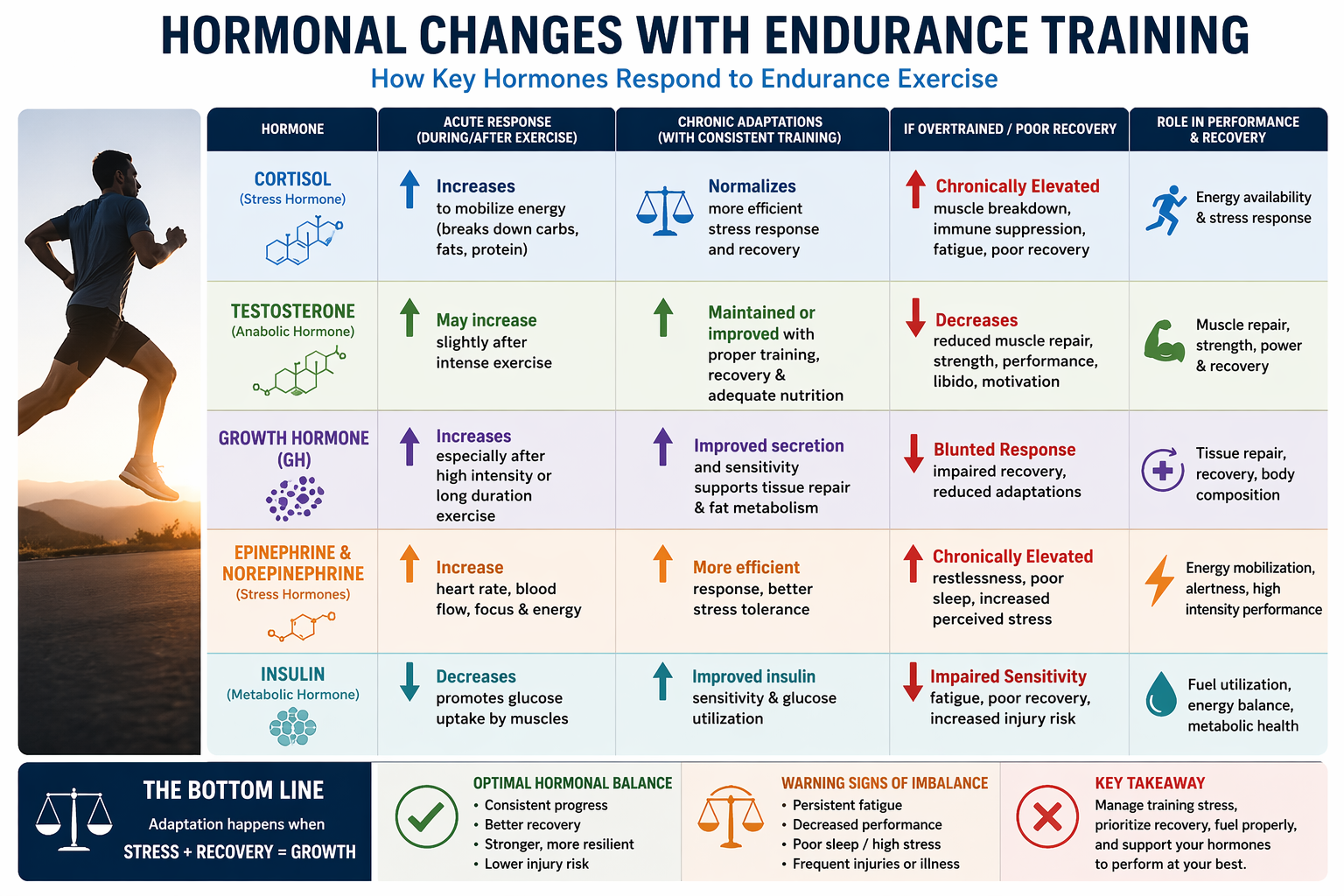
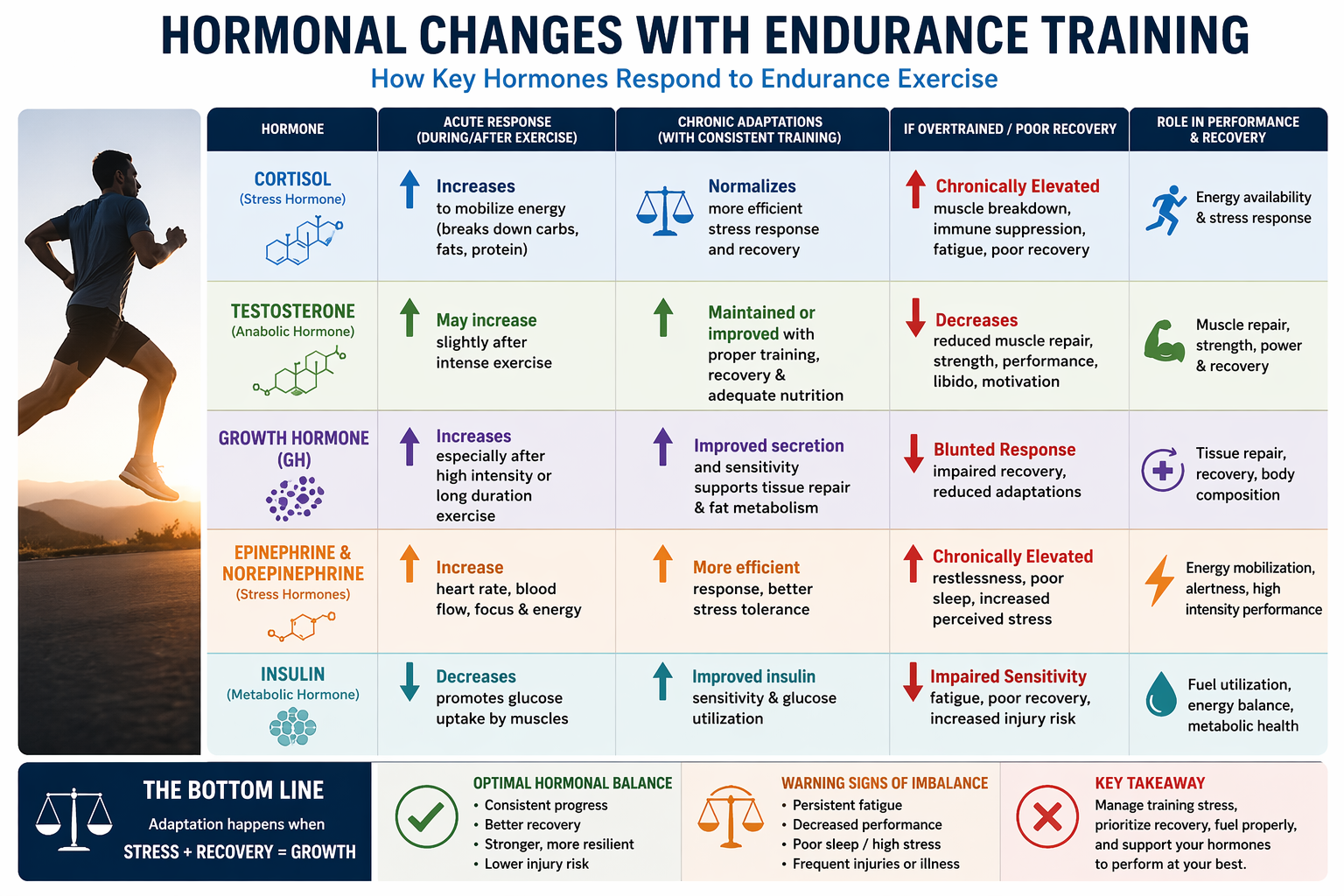
Endurance training doesn’t just challenge your muscles—it places significant demand on your hormonal system. From cortisol and testosterone to growth hormone and insulin, these internal responses dictate how well you recover, adapt, and ultimately perform. When properly managed, endurance training leads to positive hormonal adaptations that improve efficiency and resilience. But when mismanaged, it can push the body toward fatigue, poor recovery, and increased injury risk. Understanding these hormonal shifts is key to training smarter, not just harder.
What’s Happening Inside Your Body and Why It Matters
Endurance training places a significant demand on the body, and one of the most important systems involved in how we adapt to that demand is the endocrine system. At its core, training is a stressor, and your body responds hormonally in an effort to maintain balance while improving performance. When managed properly, this leads to positive adaptations such as improved aerobic capacity, better fuel utilization, and enhanced recovery. However, when training load exceeds the body’s ability to recover, those same hormonal responses can begin to work against you, increasing fatigue, slowing recovery, and raising the risk of injury.
Training as Stress: The Foundation of Adaptation
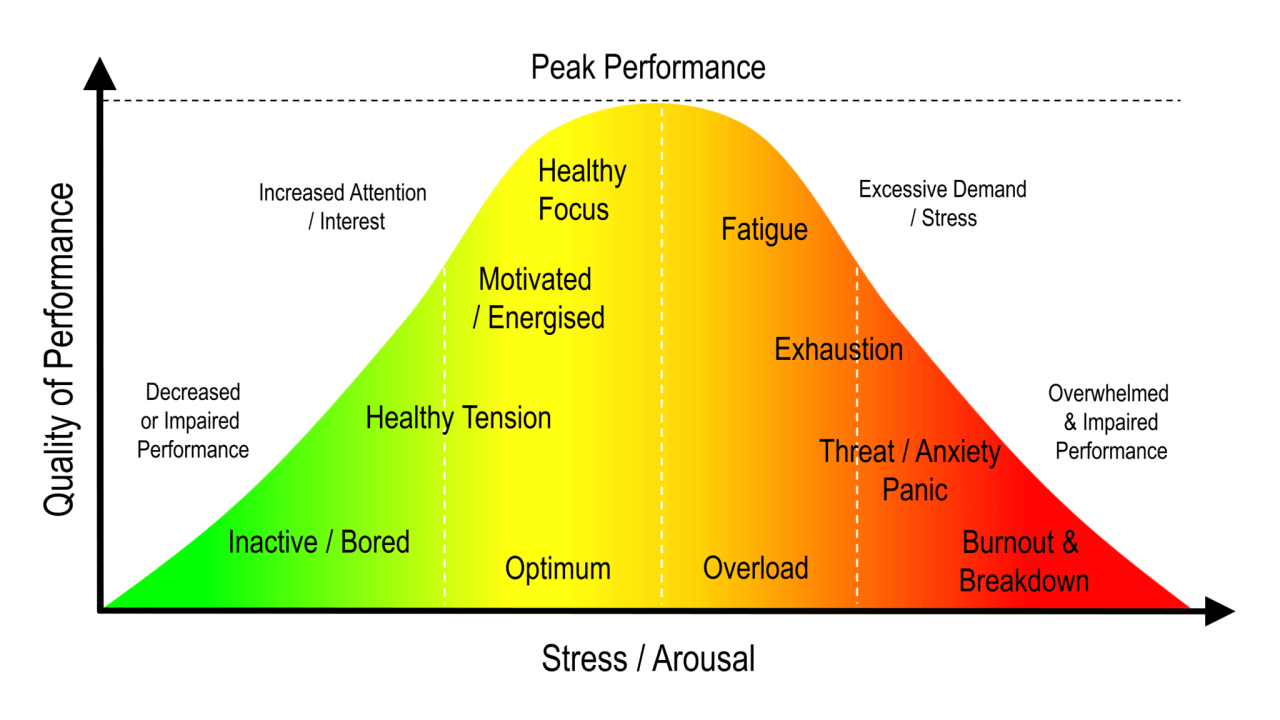
Every run you complete is a form of stress placed on the body. The goal of training is not simply to perform work, but to create a stimulus that the body can adapt to over time. Hormones are the messengers that help regulate this process. When training stress is balanced with adequate recovery, the body adapts by becoming more efficient and resilient. When that balance is off, the body shifts toward breakdown rather than progress, which is where many endurance athletes run into trouble.
Cortisol: The Double-Edged Sword
Cortisol plays a central role in endurance performance. It helps mobilize energy by breaking down stored fuel, allowing you to sustain longer efforts. In the short term, this is a necessary and beneficial response. However, problems arise when cortisol levels remain elevated for extended periods due to excessive training, lack of sleep, or poor recovery habits. Chronically high cortisol levels can lead to increased muscle breakdown, reduced immune function, and a persistent sense of fatigue. This is often what we see in runners who feel like they are doing everything right but continue to feel worn down.
Testosterone: The Recovery and Performance Hormone
Testosterone is critical for muscle repair, strength maintenance, and overall recovery. While endurance training does not eliminate testosterone production, high volumes of training without adequate recovery can suppress its levels. This creates a less favorable environment for rebuilding tissue and maintaining strength. As a result, athletes may notice slower recovery, decreased performance, and a lack of power. This is one of the key reasons why endurance athletes benefit from incorporating strength training into their programs, as it helps support a more balanced hormonal profile.
Growth Hormone: Supporting Repair and Adaptation
Growth hormone is heavily involved in tissue repair, muscle recovery, and fat metabolism. Endurance exercise, particularly at higher intensities, can stimulate increases in growth hormone, which supports the body’s ability to recover and adapt. However, these benefits are only realized when recovery is adequate. Without proper sleep and nutrition, the body cannot fully take advantage of these hormonal responses, limiting the effectiveness of training.
Stress Hormones and the Nervous System
Epinephrine and norepinephrine are released during endurance training to increase heart rate, improve blood flow, and enhance energy availability. These hormones are essential for performance and allow the body to meet the demands of training. In a well-balanced program, their effects are temporary and return to baseline after exercise. However, when training stress is too high or recovery is insufficient, the body can remain in a heightened state of stress. Athletes may experience poor sleep, increased anxiety, and declining performance despite continued effort.
Insulin and Energy Availability
One of the positive effects of endurance training is improved insulin sensitivity, which allows the body to use carbohydrates and fats more efficiently for fuel. This is a major advantage for endurance athletes. However, this benefit depends heavily on proper fueling. When athletes do not consume enough calories to match their training demands, the body enters a state of low energy availability. This can disrupt multiple hormonal systems, impair recovery, and negatively impact performance.
When Hormonal Balance Breaks Down
The issue for most endurance athletes is not the training itself, but the imbalance between stress and recovery. When athletes consistently push their training without allowing the body to recover, the hormonal environment shifts toward breakdown. This often presents as chronic fatigue, persistent soreness, plateaued performance, and an increased risk of overuse injuries such as shin splints, stress reactions, and tendon-related issues. Over time, this cycle can be difficult to break without adjusting both training and recovery strategies.
Optimizing Hormonal Health for Performance
Improving the hormonal response to endurance training requires a comprehensive approach. Training load must be managed appropriately, ensuring that not every session is high intensity and that recovery days are built into the program. Strength training should be included to support testosterone levels and improve tissue capacity. Proper nutrition is essential, particularly adequate intake of carbohydrates and protein to support energy demands and recovery. Finally, sleep plays a critical role, as many of the body’s key recovery processes and hormonal regulations occur during deep sleep.
Final Thoughts
Understanding the hormonal effects of endurance training provides a clearer picture of why some athletes thrive while others struggle despite similar training volumes. Performance is not simply about how much you train, but how well your body is able to adapt to that training. By creating the right internal environment through balanced training, proper recovery, and intentional programming, endurance athletes can improve performance, reduce injury risk, and sustain long-term progress.
At Momentous PT, we don’t just rehab injuries—we help athletes understand their bodies at a deeper level. That means optimizing how you train, recover, and perform by looking at everything that drives progress, including your hormonal response to training. Our goal is to get you out of pain, rebuild your capacity, and put you in a position where you’re not just healthy, but performing at your highest level with confidence.

Tendon Pain: What It Is, Why It Happens, and How to Fix It
Dealing with knee, Achilles, or foot pain that won’t go away? Learn what tendon pain really is, why it happens, and how to fix it so you can get back to training without setbacks.
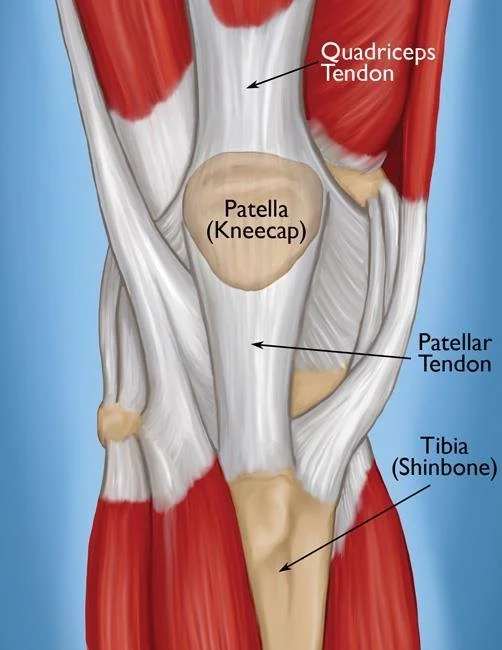
If you’ve been dealing with pain in your knee, Achilles, or foot that just won’t go away — especially with running, jumping, or training — there’s a good chance you’re dealing with tendon pain.
This is one of the most common issues I see in athletes, whether that’s runners, basketball players, volleyball players, or anyone who’s consistently loading their body. And just like most overuse injuries, it’s often misunderstood and mistreated.
What Is Tendon Pain?
Tendons are the structures that connect muscle to bone, but they’re not just passive tissues. They play a major role in how your body moves and performs.
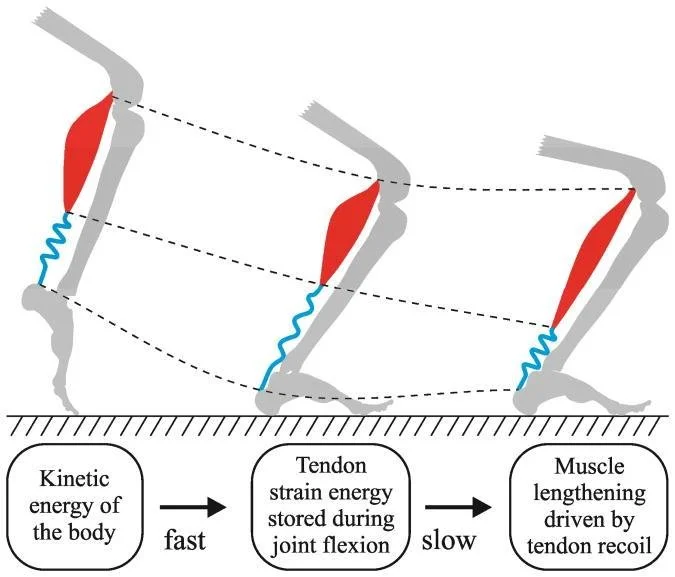
Every time you sprint, jump, or land, your tendons act like springs. They absorb force and then release it back into your body, helping you move more efficiently and powerfully. This is a big reason why explosive athletes rely so heavily on healthy tendons.
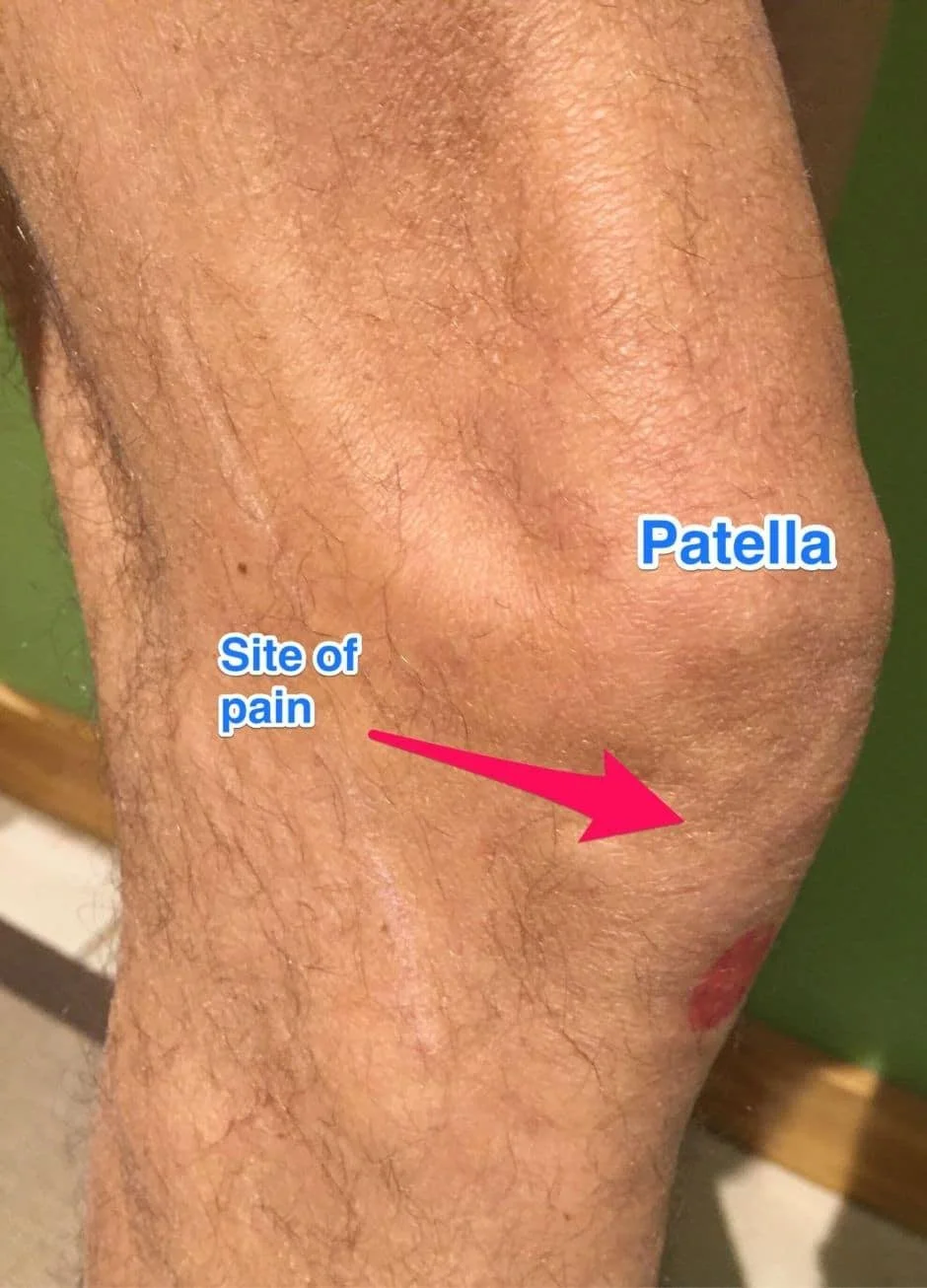
When a tendon becomes irritated, the symptoms are usually pretty consistent. You’ll feel pain in a very specific spot, typically with activity like jumping, sprinting, or lifting. It’s common to feel stiff at the start of a workout or first thing in the morning, and sometimes the pain actually improves once you get moving.
Why It Happens (The Truth Most People Miss)

Most people are told tendon pain is inflammation or a small tear, but that’s usually not the full picture.
Tendon pain is primarily a load management problem. It shows up when the amount of stress placed on a tendon exceeds what it can currently handle. This can happen when training volume increases too quickly, when intensity ramps up, or when there’s not enough recovery between sessions.
Athletes who jump a lot, sprint frequently, or train at high intensity are especially prone to this. Over time, the tendon can start to lose efficiency. The internal structure becomes a bit more disorganized, and it doesn’t handle force as well as it should.
But the important thing to understand is this: your tendon isn’t weak — it’s just not prepared for the demands you’re placing on it yet.
How to Tell If It’s Tendon Pain
Tendon pain tends to follow a predictable pattern. Most people can point to one very specific spot where it hurts. The pain usually increases with activity, especially movements that load the tendon like jumping, running, or lifting.
A unique feature of tendon pain is the “warm-up effect.” It might feel stiff or painful at first, but as you continue moving, it can actually start to feel better. Then later on, or the next morning, the stiffness and soreness come back.
This pattern is a big clue that you’re dealing with a tendon issue rather than a muscle or joint injury.
What Most People Get Wrong
This is where a lot of people get stuck.
The typical advice is to rest, stretch, foam roll, or get some kind of passive treatment. While that might give temporary relief, it doesn’t actually fix the problem.
Tendons don’t respond well to being completely unloaded. In fact, even a couple of weeks of doing nothing can reduce their ability to handle stress. On the flip side, pushing through pain without any structure just keeps irritating the tissue.
That’s why so many people feel like their tendon pain keeps coming back. They either do too little or too much, with no real plan in place.
What Actually Helps
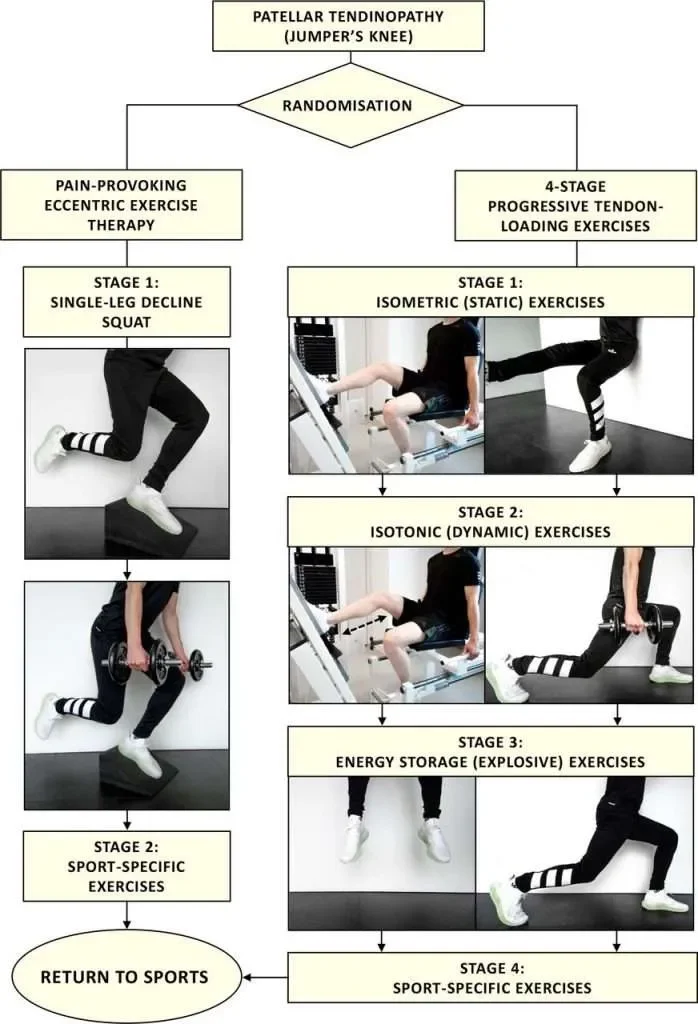
The key to fixing tendon pain is progressive loading.
That means giving the tendon just enough stress to stimulate adaptation, but not so much that it gets overwhelmed. When you hit that balance, the tendon starts to rebuild, get stronger, and handle force more efficiently.
The first step is managing your overall load. You don’t have to stop everything, but you do need to adjust your training. That might mean temporarily reducing high-impact movements, avoiding sudden spikes in activity, and being more intentional about recovery.
From there, we introduce isometric exercises. These are controlled holds under tension that can help reduce pain and begin loading the tendon in a safe way. As symptoms improve, the focus shifts to strength training. Slow, controlled lifting helps rebuild the tendon’s structure and improve its ability to handle load.
Eventually, you have to train the tendon to do what it was designed to do. That means progressing into more dynamic movements like jumping, sprinting, and changing direction. This is where a lot of people fall short, and it’s one of the biggest reasons tendon pain keeps coming back.
Gradual Return to Sport
Returning to full activity isn’t about flipping a switch — it’s a progression.
You start with lower-level movements and build your way back up over time. As you do this, it’s important to pay attention to how your body responds. Not just during the activity, but afterward and the next day as well.
If symptoms stay controlled, you continue progressing. If they spike, you pull things back slightly and adjust. This process allows you to rebuild capacity without constantly setting yourself back.
The Bottom Line
Tendon pain isn’t something you just rest away.
It’s a load and capacity problem, and the solution is building your body back up to handle the demands of your sport or activity.
The goal isn’t to avoid stress — it’s to become resilient to it.
Need Help?
If you’ve been dealing with knee, Achilles, or foot pain that keeps coming back, it’s usually because the loading hasn’t been managed properly or the progression hasn’t been structured the right way.
Having a plan makes all the difference.
If you want to get back to training, competing, and performing without constantly worrying about pain, book an evaluation and we’ll map out exactly what your next steps should look like.

IT Band Pain: What It Is, Why It Happens, and How to Fix It
IT Band Pain: What It Is, Why It Happens, and How to Fix It
If you’ve ever felt a sharp pain on the outside of your knee during a run, there’s a good chance you’ve dealt with IT band pain. It’s one of the most common injuries I see in runners and active people — and one of the most misunderstood.
What Is IT Band Pain?
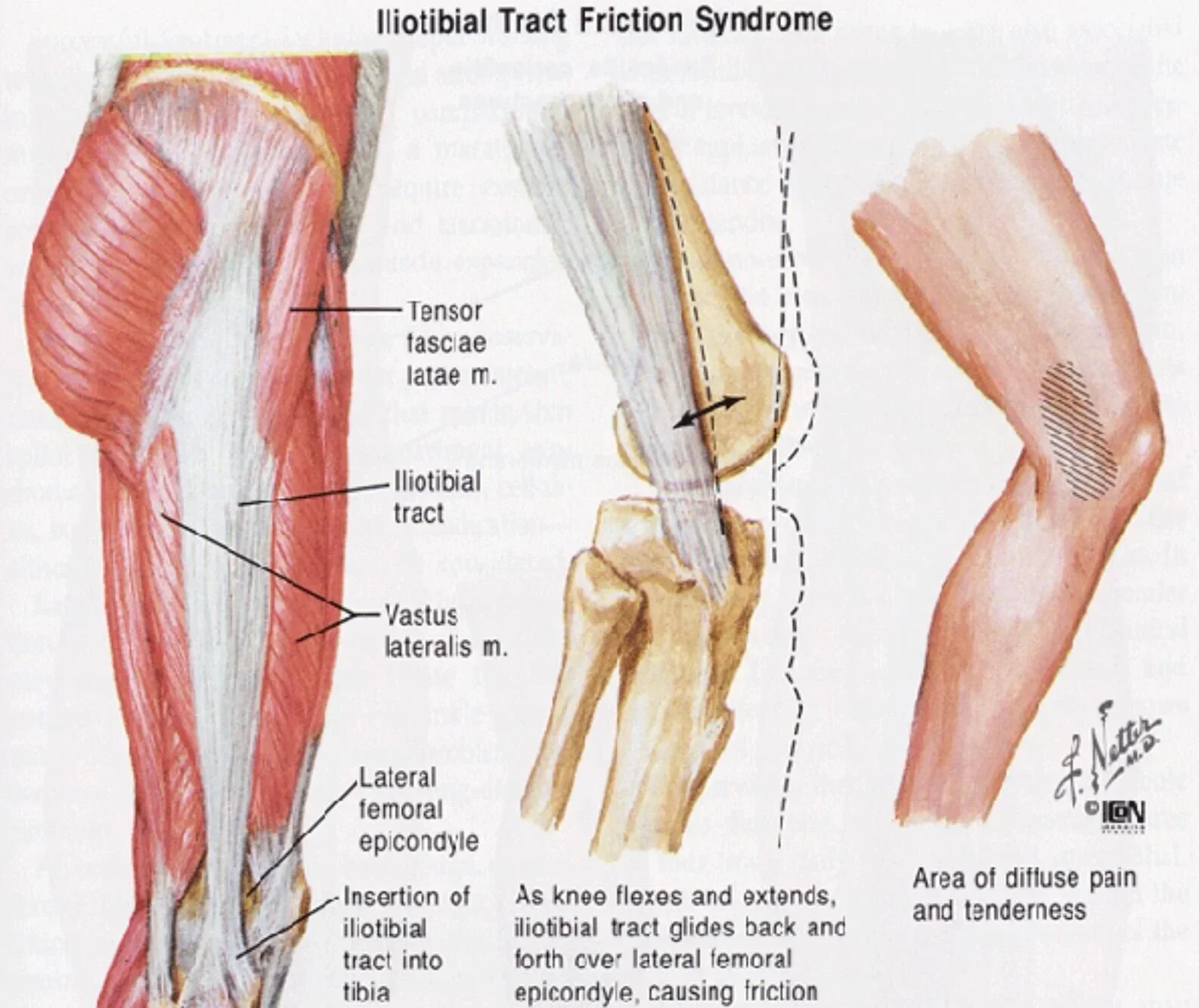
Your IT band is a thick piece of connective tissue that runs from your hip down to your knee. You can think of it as a strong outer support system for your leg. Its role is to help stabilize your knee, control rotation, and transfer force when you’re walking or running.
When this area becomes irritated, it typically shows up as a sharp or burning pain on the outside of the knee. Most people notice it gets worse with running, going down stairs, or downhill movement, and it tends to build the longer you stay active. This is why it’s commonly classified as an overuse injury, especially in runners.
Why It Happens (The Truth Most People Miss)
A lot of people are told their IT band is “tight” and needs to be stretched. While that sounds logical, it’s not the full picture.
We used to think the IT band was rubbing back and forth on the outside of the knee causing friction. But newer understanding suggests it’s more of a compression issue. The irritation is likely coming from sensitive tissue underneath the IT band — like a fat pad or bursa — getting repeatedly compressed during movement.
A simple way to think about it is like having a rock in your shoe. The problem isn’t the shoe itself — it’s what’s getting irritated underneath.
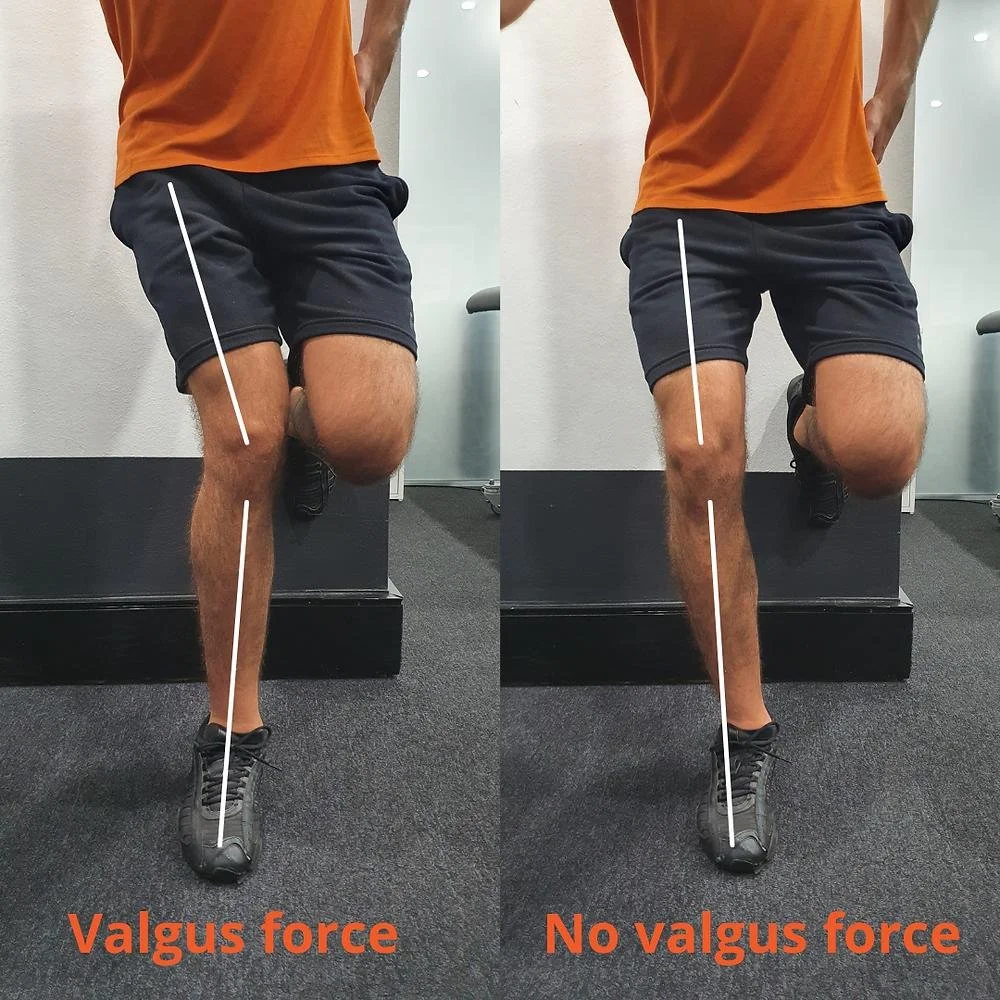
This compression tends to build when training load exceeds what your body can handle. That can happen with sudden increases in mileage, intensity, or hills, especially downhill running. It’s also influenced by how well your body controls movement. Poor single-leg control, increased hip drop, and the knee collapsing inward can all increase stress on the outside of the knee. As fatigue sets in, these movement patterns often get worse, which is why symptoms tend to build over time rather than appear instantly.
How to Tell If It’s IT Band Pain
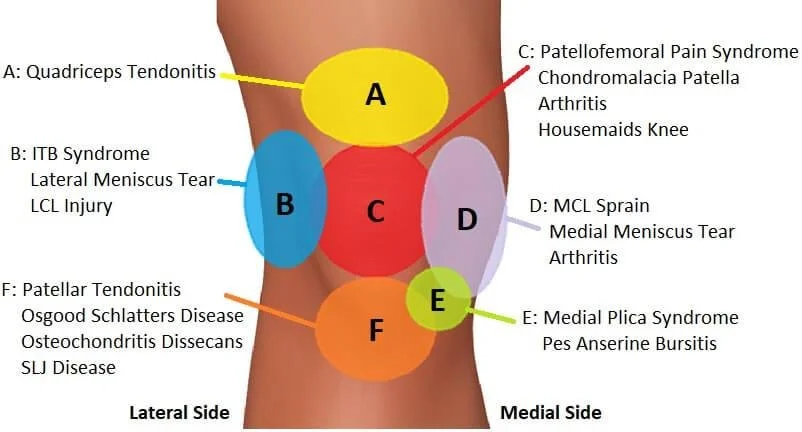
IT band pain is usually very specific. Most people can point to a small spot on the outside of their knee, often just above the joint line. The pain tends to come on gradually and is most noticeable during activities like running downhill or going down stairs.
It’s important to distinguish this from other types of knee pain. Pain in the front of the knee is more likely something like patellofemoral pain, while deeper or more constant pain could point to a different issue altogether. Because of this, IT band pain is often considered a diagnosis of exclusion — meaning we rule out other causes before confirming it.
What Actually Helps
This is where a lot of people go wrong. Most treatments focus on trying to “loosen” the IT band through stretching or aggressive foam rolling. In reality, these approaches don’t address the root problem and can sometimes make things worse by increasing compression in an already irritated area.
What actually works is a more strategic approach focused on load management, strength, and control.
The first step is managing your activity. This doesn’t mean complete rest, but it does mean temporarily reducing or modifying movements that aggravate your symptoms. Downhill running, in particular, should be limited early on since it places the most stress on the outside of the knee.
From there, the focus shifts to building strength and control — especially with single-leg movements. Improving hip stability and preventing the knee from collapsing inward are key pieces of the puzzle. This is less about doing random exercises and more about retraining how your body moves under load.
Improving running mechanics can also make a big difference. Small adjustments, like slightly increasing your step rate, can reduce the amount of stress going through the knee with each step.
Gradual Return to Running
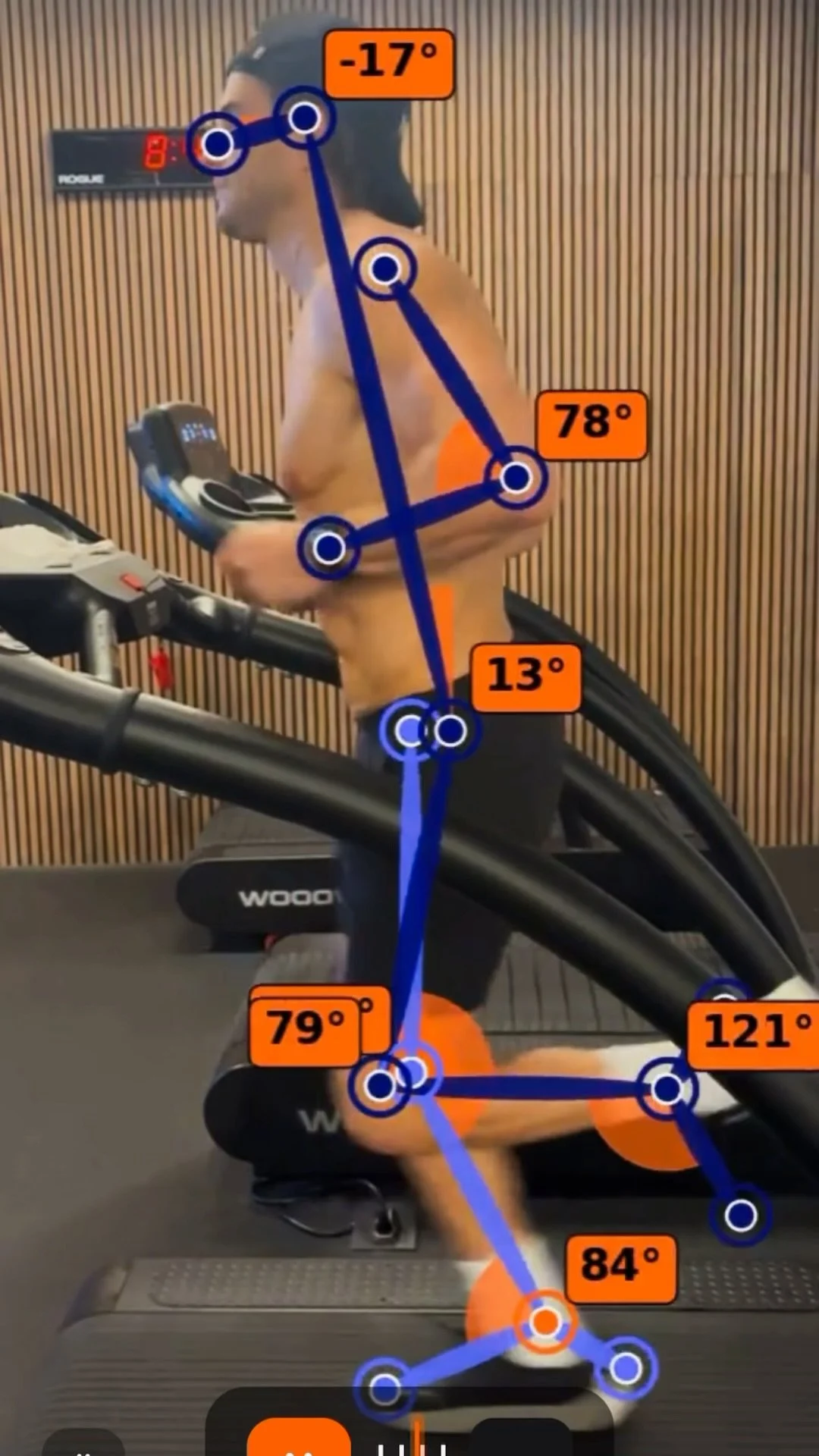
As symptoms improve, the goal is to return to running in a controlled and progressive way.
This usually starts with walking, especially if you’re still having pain. From there, you can progress into run-walk intervals before jumping back into continuous running. It’s important to avoid downhill running early in this phase, since that tends to be the most aggravating.
The key is to build back gradually, increasing volume and intensity over time rather than all at once. A good mindset here is to earn the right to run again instead of rushing back too quickly.
The Bottom Line
IT band pain isn’t just a tightness issue.
It’s a load and control problem that leads to irritation on the outside of the knee. The goal isn’t to loosen the IT band — it’s to build a body that can handle the demands of running or activity.
Need Help?
If your IT band pain keeps coming back, it’s usually because the underlying issue hasn’t been fully addressed or you’re progressing faster than your body is ready for.
A structured plan can make all the difference.
If you’re dealing with this and want to get back to running pain-free, book an evaluation and we’ll map out exactly what you need to move forward with confidence.